

Fractional Design Director for mission-led teams
How it works.
Most organisations don't have a design problem. They have a deciding problem: nobody owns what the brand should and shouldn't do, so every piece of work reopens the question. I close it. Here's what that looks like in practice.
Audit (two days)
I look at your organisation in four places:
-
How you're recognised
-
Who decides and how
-
What it's like to deal with you
-
What others do in your name
You get written findings, the three things to fix first, and a 60-minute readout. Fixed price.
-
Proposal
Based on the audit: a retainer, a project, Hands-on days, training your own keeper, or nothing at all. Written in plain language with a price, a scope and a start date.
First month
- A kickoff with whoever makes decisions about the brand.
- The standard, written down: what the brand protects, what good looks like, what would weaken it. One page, in your words, with my name and your keeper's against it.
- Your keeper named: the one person on your side who holds the standard between my days. We agree which kinds of work always come to me.
- Your portal set up: one place for the standard, requests, reviews, approvals and files.
- The first review cycle, so your team sees how fast decisions come back.
A normal month on retainer
- A planning session at the start: what's coming, what matters, what can wait.
- Requests come through the portal, tagged quick, project or decision.
- Your keeper checks everyday work against the standard and logs the call. The pieces that carry the most weight come to me.
- Reviews turned round inside 48 hours, each one checked against the standard.
- A sample of the month's everyday decisions read back, so drift is caught early.
- A monthly note: what shipped, what we decided and why, one recommendation.
Checked against
A yes is never just a yes. It is a yes against something written down.
Pick a piece of work. What went wrong, the line that caught it, and the fix.
The problem
The sponsor redrew our logo in their colours.
The standard says
Partners use the lock-up we supply. No new versions.
The fix
Send them the real one. Their colour stays in their panel.
The problem
Three things on the cover are green.
The standard says
One green. It marks one thing per layout.
The fix
Keep it on the headline figure. Lose the rest.
The problem
The agency built their own. The type has drifted.
The standard says
Agencies and freelancers start from our templates.
The fix
Rebuild from our file. An afternoon, not a rebrand.
The problem
New donors wait a week to hear from us.
The standard says
A first-time supporter is thanked within a day, in plain words.
The fix
Send it the same day. Short and plain.
The problem
Three people need to approve the film.
The standard says
The head of comms approves anything public. One person can say no.
The fix
Name one approver. The other two get a preview.

The days
What the days are for.
The days are for direction, decisions and review. Making the work is separate, so it never crowds them out.
Two days
The planning session, your decisions inside 48 hours, a full review of the pieces that carry the most weight, the monthly sample and note.
Four days
All of that, plus briefing your agencies and freelancers, a working session with your keeper, and one project set up and checked at its key points.
Six days
All of that, plus leading a major piece of work through its decisions: a rebrand, a new website or a reporting cycle.
Need the work made as well? That's Hands-on days or a project, alongside.
When to bring me in
- Before a rebrand or a website rebuild. Most of the time you need the standard, not the rebrand.
- Before hiring a designer or appointing an agency, so they have something to work to.
- When the comms lead has become the design bottleneck.
- When the brand, website and reports no longer look like the same organisation.
- When too much work is being redone because nobody could say what good looked like.
What you own
Everything. The standard, final files, source files, logins. Leaving me never means losing your work. The standard is written so that it outlasts me. If you want someone in-house to hold it from day one, I can train them.
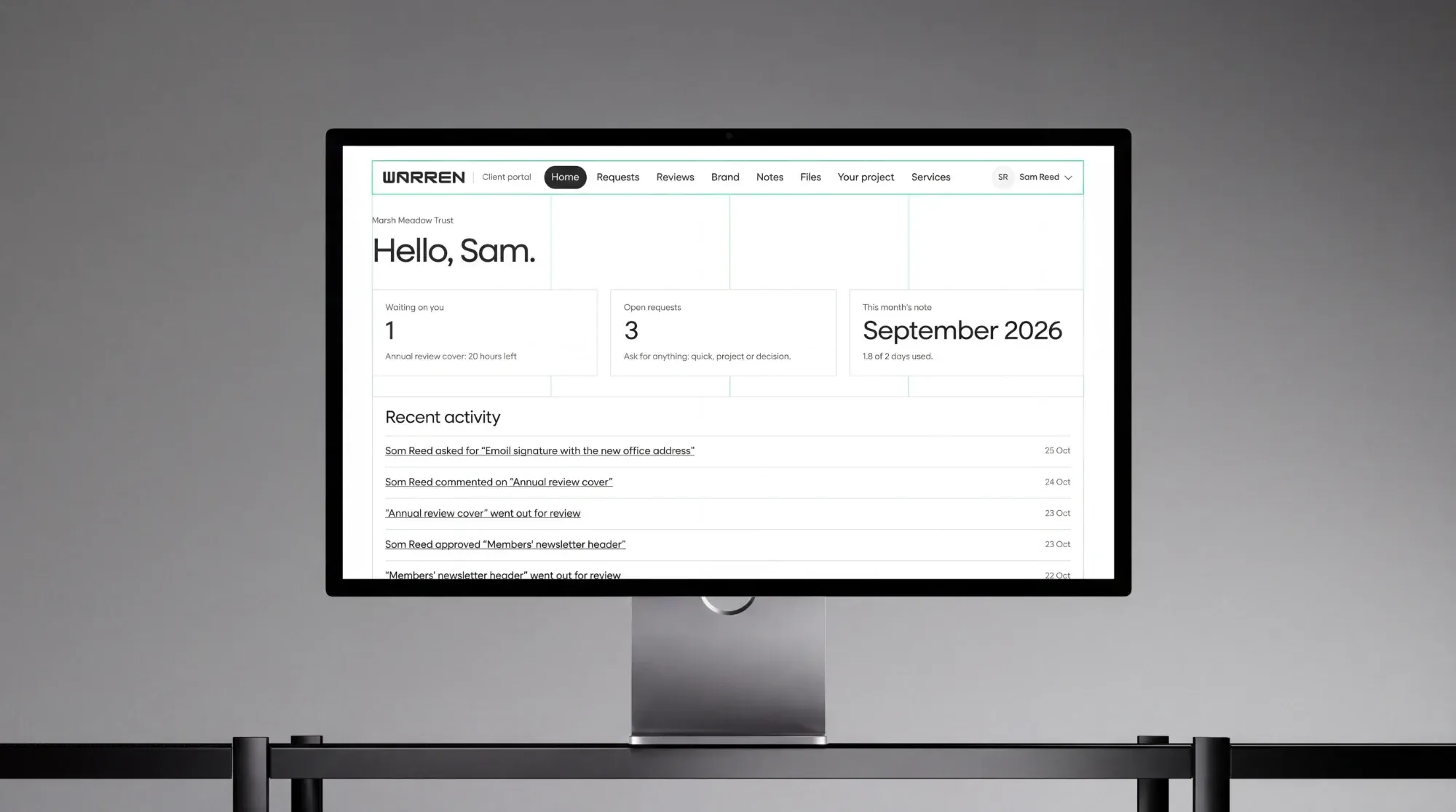
One place for the standard, the requests, the approvals and the files. Nothing lives in email. Example data.